How to Recognise Quality CBD: The Guide to Making the Right Choice
The CBD market has grown considerably in France, and not all products are equal. Whether you are looking at flowers, resins, or extracts, identifying quality CBD requires a few clear reference points. This guide gives you concrete keys, from supply chain traceability to visual and sensory signals, so you can choose with confidence.
Supply Chain Traceability: The Primary Quality Criterion
The most reliable indicator for recognising quality CBD is traceability. A serious seller knows where their flowers and extracts come from: the variety, the growing region, the harvesting and drying method. This transparency about the supply chain reveals a direct producer who stands behind their source, far more than any commercial pitch.
A direct, short supply chain limits intermediaries and grey areas. You know who grows, how, and according to what selection criteria. It is this clear link between the field and the finished product that sets serious operators apart from opaque resellers.
An analysis certificate can complement this traceability: it is a welcome extra among others, but it does not replace a transparent supply chain and should not be treated as the sole quality indicator. A seller who clearly explains the origin of their products already tells you a great deal about their professionalism.
- Clear origin: variety, cultivation, harvest, and drying communicable on request
- Direct and short supply chain, with no opaque intermediaries
- A direct producer who stands behind and documents their source
- Analysis certificate: a useful extra among others, not a mandatory prerequisite
Declared CBD Percentage and Compliant THC Level
The stated CBD percentage must remain consistent with the variety and product type. Be wary of excessively high percentages paired with abnormally low prices: the quality of extraction and the raw material come at a real cost, and if a figure sounds too good to be true, it often is.
In France, the THC level must remain below 0.3% in the finished product. This is the legal threshold, and every legally sold product respects it. A serious seller displays this information clearly and does not try to sidestep it.
A rich profile, with several cannabinoids and a broad range of terpenes, often signals a carefully selected raw material rather than a diluted formulation. This is a quality indicator you will also detect through the aroma.
- CBD percentage consistent with the variety and format
- THC below 0.3%, compliant with French law
- Be cautious of very high percentages at abnormally low prices
- Rich cannabinoid and terpene profile: a good quality signal
Clean Growing Practices: Why the Supply Chain Matters
Hemp is a bioaccumulator: it absorbs what is in the soil and air. The quality of a CBD product is therefore determined first in the field, through growing practices. Healthy soil, without aggressive inputs, and a careful harvest are the true starting guarantee.
This is where a direct supply chain comes into its own: when you know where and how the plant was grown, you also know the conditions in which it developed. A traceable supply chain, with rigorous practices, is the most reliable everyday benchmark for a clean product.
Laboratory analysis can provide additional insight into any potential residues, complementing this traceability. This is a useful extra, but control over the growing process remains decisive.
- Careful cultivation on healthy soil, without aggressive inputs
- Traceable supply chain: you know where and how the plant grew
- Rigorous harvesting and drying practices
- Laboratory analysis: a useful complementary perspective
Visual Appearance, Aroma and Terpenes: The Sensory Signals
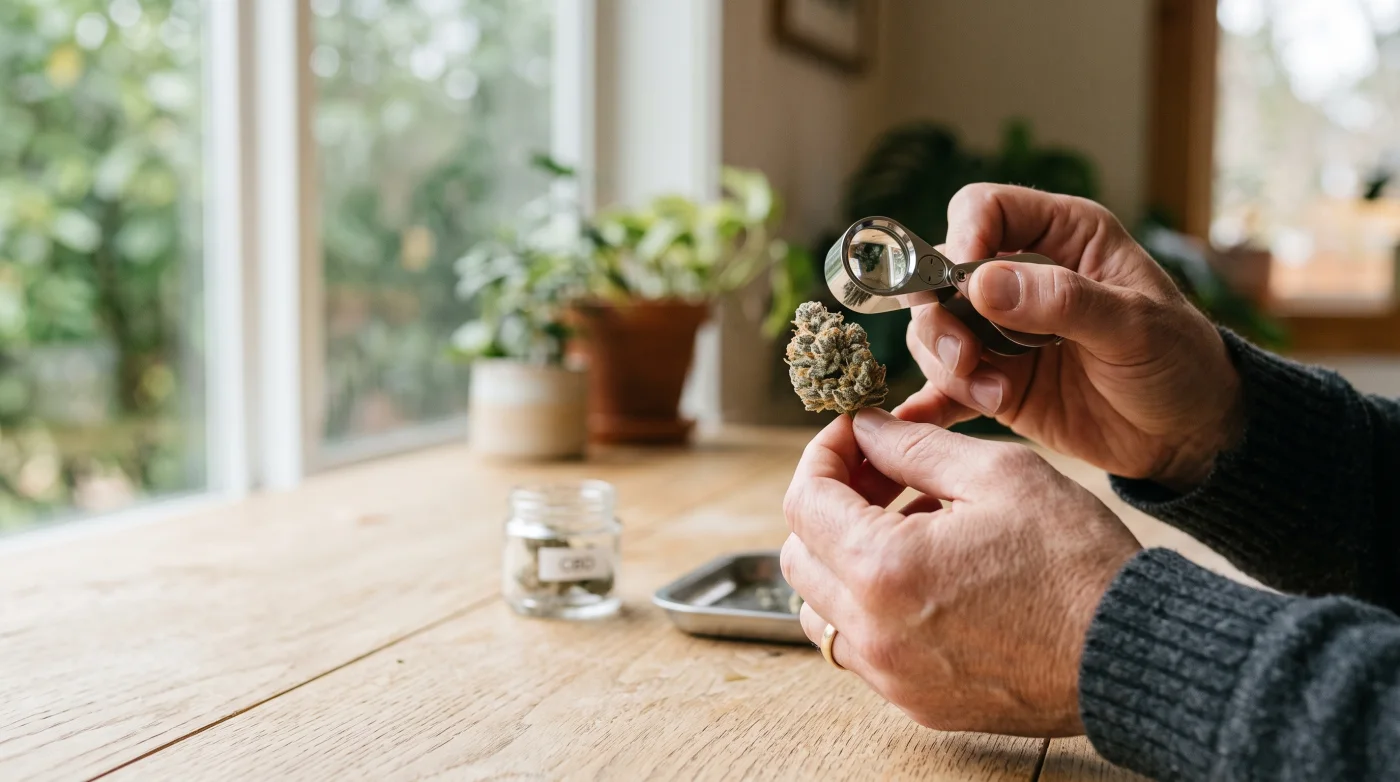
Sensory signals are your best everyday allies: quality CBD is recognisable by eye and by nose. A quality flower displays visible, abundant trichomes, and a consistent colour ranging from light to deep green, sometimes with purple tones.
The aroma indicates terpene richness: complex and persistent notes (earthy, fruity, floral, resinous). A mediocre CBD has a depleted, chemical, or absent scent, a sign of poor harvesting or storage.
The structure should be dense without being compressed, well-trimmed and dry to the touch without being crumbly. Excessive moisture encourages mould; too little deteriorates the terpenes. These concrete, accessible markers are at the heart of any good purchase decision.
- Visible, abundant trichomes in good condition
- Consistent, natural colour for the variety
- Rich, complex and persistent aroma
- Well-trimmed structure, dense but not compressed
- Correct moisture level: neither too dry nor too damp
Traceability and Storage: The Guarantees of a Serious Supply Chain
Quality CBD is traceable: the seller can indicate the variety, growing conditions, harvest date, and drying method. This transparency is the hallmark of a direct producer who stands behind their source.
Packaging matters too: airtight and opaque containers (glass or aluminium) protect against air, light, and moisture. A readable batch number and expiry date are non-negotiable.
The transport and storage chain deserves attention: a product that has been poorly stored can lose some of its aromatic qualities, even if it was perfect when it left the producer.
- Variety, harvest date, and drying method communicable on request
- Airtight, opaque packaging protected from light
- Readable batch number and expiry date
- Controlled transport and storage conditions
- Traceable supply chain with an identifiable direct producer
Questions fréquentes
What is the most important criterion for recognising quality CBD?
Supply chain traceability. A serious seller knows where their flowers and extracts come from, and according to what selection criteria. This transparency, combined with visual and olfactory signals (appearance, aroma, trichomes) and a THC level below 0.3%, is the best quality guarantee.
What is a Certificate of Analysis (COA) used for?
A COA is a document that details a product's composition: CBD level, THC level, and any potential residues. It is a welcome addition that complements supply chain traceability, without being a mandatory prerequisite or the sole quality indicator.
How can I be sure the THC is below 0.3%?
The THC level must be clearly displayed on the product listing: this is the legal threshold in France. A seller working within a direct and traceable supply chain will be able to confirm this information and the origin of their products.
Are terpenes useful for assessing quality?
Yes: they are responsible for the aromas. A product rich in terpenes has a complex and persistent scent, a sign of a careful harvest and good storage. A chemical or absent odour signals degradation.
Can you trust a CBD product with no information about its origin?
No. The absence of information about the supply chain is a red flag. A serious producer always documents their production chain. Supply chain transparency is a selection criterion in its own right.