
CBD Terpenes and the Entourage Effect: Understanding the Aromatic Richness of Hemp
Behind every CBD flower lies a signature invisible to the eye but immediate to the nose: terpenes. These aromatic molecules define the olfactory character of each variety, and their interaction with cannabinoids gives rise to what researchers call the entourage effect.
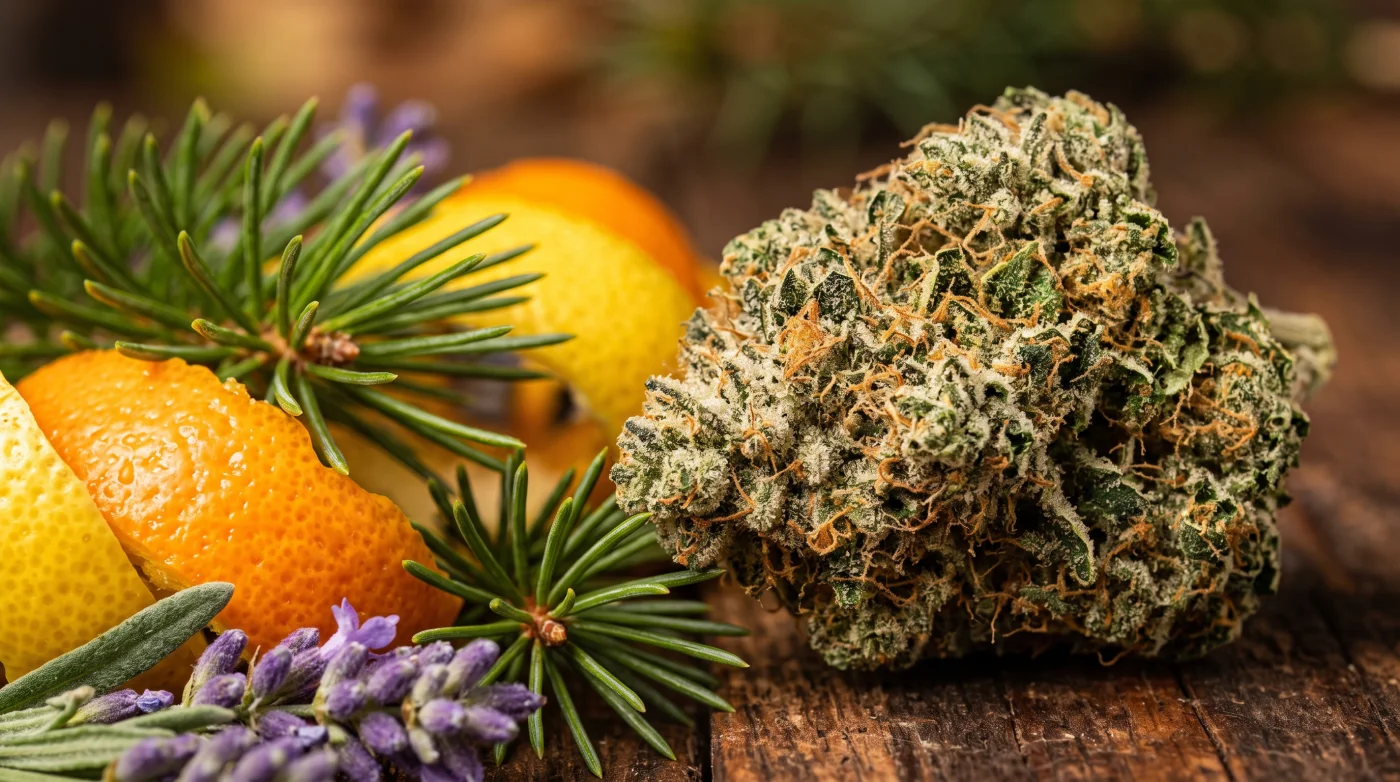
What Is a Terpene?
Terpenes are aromatic hydrocarbons produced naturally by many plants, from lemon to lavender, pine to mango. In hemp (Cannabis sativa L.), they are synthesised in the same glands as cannabinoids (the trichomes) and make up the most volatile and aromatic part of the plant.
Over 150 different varieties have been identified in hemp alone. Each cultivar has its own terpene profile, which explains why two legal CBD flowers can smell so different: one evokes citrus, another a pine forest, a third the earthy scent of rain on soil.
At BeBud, every flower from our traceable supply chain is selected and assessed for its dominant terpenes. This transparency allows you to choose your variety not only by CBD rate, but also by aromatic profile, the same way you might choose a tea or coffee by its tasting notes.
The Main Terpenes and Their Aromatic Profiles
Here are the terpenes you will encounter most often in BeBud varieties, with their characteristic olfactory signatures.
These profiles are purely sensory and aromatic: they describe the olfactory and taste experience, not physiological effects.
- Limonene: bright citrus notes (lemon, orange, grapefruit). Fresh and lively scent.
- Myrcene: earthy, slightly musky profile with hints of mango and hops. One of the most abundant in hemp.
- Pinene: clean, resinous scent of pine forest, sometimes with a herbaceous edge.
- Linalool: delicate floral notes of lavender, rose, and lily of the valley.
- Caryophyllene: spicy, peppery, slightly woody profile close to black pepper.
- Humulene: herbaceous, earthy, and woody aroma, close to hops.
- Terpinolene: floral, herbaceous, and slightly smoky notes, very distinctive.
- Ocimene: fresh, sweet, slightly fruity and herbaceous.
The Entourage Effect: When Compounds Work Together
The entourage effect refers to the synergy between the different natural compounds of hemp (cannabinoids such as CBD, CBG, CBN, and CBC, terpenes, and flavonoids) when they are present together in their natural state.
The concept was first described in scientific literature by researchers Raphael Mechoulam and Shimon Ben-Shabat in the late 1990s, then developed by Dr Ethan Russo. Preliminary studies suggest that hemp compounds may interact in a more complex way together than in isolation, though research is still ongoing and definitive conclusions require further clinical trials.
What this means in practice: a full-spectrum CBD flower, with its preserved terpene profile, offers a richer sensory and aromatic experience than a pure CBD isolate. This is not a medical promise, but a quality distinction, similar to the difference between freshly squeezed juice and a reconstituted flavouring.
Full Spectrum, Broad Spectrum, or Isolate?
CBD products come in three main profiles, and terpenes play a central role in this distinction.
Full spectrum retains all the natural compounds of the plant. It is the profile closest to a fresh flower and the most conducive to the entourage effect. Broad spectrum retains terpenes and minor cannabinoids, but THC has been removed or reduced below the legal threshold (below 0.3%). An isolate, finally, is CBD at 99% or more, without terpenes or entourage effect.
BeBud full-spectrum flowers are dried using processes that preserve volatile terpenes as much as possible: this is one reason why the aromatic profile of each variety is so pronounced when you open the bag.
- Full spectrum: terpenes plus cannabinoids plus THC traces below 0.3%, maximum aromatic profile
- Broad spectrum: terpenes plus minor cannabinoids, THC absent, good complexity
- CBD isolate: zero terpenes, neutral olfactory profile, maximum purity but reduced sensory experience
How to Read the Terpene Profile of a BeBud Flower
On every BeBud product page you will find the dominant terpenes of the variety, listed in order of concentration. This information helps you guide your choice based on your olfactory preferences, much like tasting notes in wine.
Myrcene-dominant varieties will be earthier and rounder; limonene-dominant ones, bright and fruity. A profile rich in linalool will suit fans of delicate florals, while a pronounced humulene will appeal to those who enjoy woody notes.
Reading terpene profiles is an invitation to explore the BeBud catalogue in a more nuanced and personal way, beyond the CBD rate alone.
Storing Your Flowers to Preserve Terpenes
Terpenes are volatile molecules: heat, light, and oxygen degrade them quickly. A poorly stored flower can lose a significant part of its aromatic profile within weeks, even if its CBD rate remains stable.
To preserve them as well as possible: store the flower in an airtight container (glass or aluminium zip pouch), away from direct light and heat, at a stable room temperature (ideally 15 to 20 degrees Celsius). Avoid the refrigerator, which creates condensation harmful to aromas.
At BeBud, the logistics chain is designed to minimise thermal and light exposure from the producer to your door, because the aromatic quality of a flower begins well before you open the bag.
- Airtight container in glass or aluminium
- Stable temperature of 15 to 20 degrees Celsius: avoid the fridge and heat
- Zero light: UV rays degrade terpenes and cannabinoids
- Ideal humidity: 55 to 62% relative humidity
Achetez nos variétés
Questions fréquentes
Do CBD terpenes have health effects?
Terpenes are primarily aromatic molecules that define the olfactory and sensory profile of a variety. Preliminary studies are exploring their properties, but no definitive medical conclusions have been established. BeBud makes no health claims about its products.
What is the difference between natural and added terpenes?
Natural terpenes are present in the plant from cultivation, preserved during drying. Some producers reintroduce terpenes extracted from other plant sources to compensate for losses. At BeBud, we work with flowers whose natural terpenes are intact, sourced from our traceable supply chain.
Is the entourage effect scientifically proven?
Preliminary studies, including work by Dr Ethan Russo, suggest a synergistic interaction between hemp compounds. Research is active but still incomplete: rigorous clinical trials are needed for definitive conclusions. It is a serious scientific avenue, not an established medical certainty.
How do I know which terpenes are in my BeBud flower?
Each variety displays its dominant terpenes and aromatic profile on the product page.
Is myrcene found in other foods?
Yes. Myrcene is found in significant concentrations in mango, hops, thyme, and lemongrass. It is one of the most widespread terpenes in the plant world, which makes its earthy, fruity profile immediately recognisable.
Are terpenes legal?
Yes, terpenes are fully legal aromatic plant molecules, commonly used in the food and cosmetics industries. Their presence in legal CBD flowers (THC below 0.3%) raises no regulatory issues.